
How will you water your garden? The answer to this question highly relates to where you live. If you live in the high desert regions like us, you can't only rely on rain water unless you have a truly xeric or native landscape that is designed for the natural precipitation (12 inches of moisture per year for us and that’s not a lot). What you’ll read here will be geared toward the high desert regions with fairly traditional plant selections as a starting point. If you live in another region but don’t know the annual precipitation rate, we recommend researching that number and choosing plants based on what your local nurseries have in stock and recommend you plant based on how much you want to supplementally water: high, medium, or low (we aim for low use unless growing food)
The most efficient ways to supplementally water are
drip irrigation
and over-head sprinklers
Other forms are
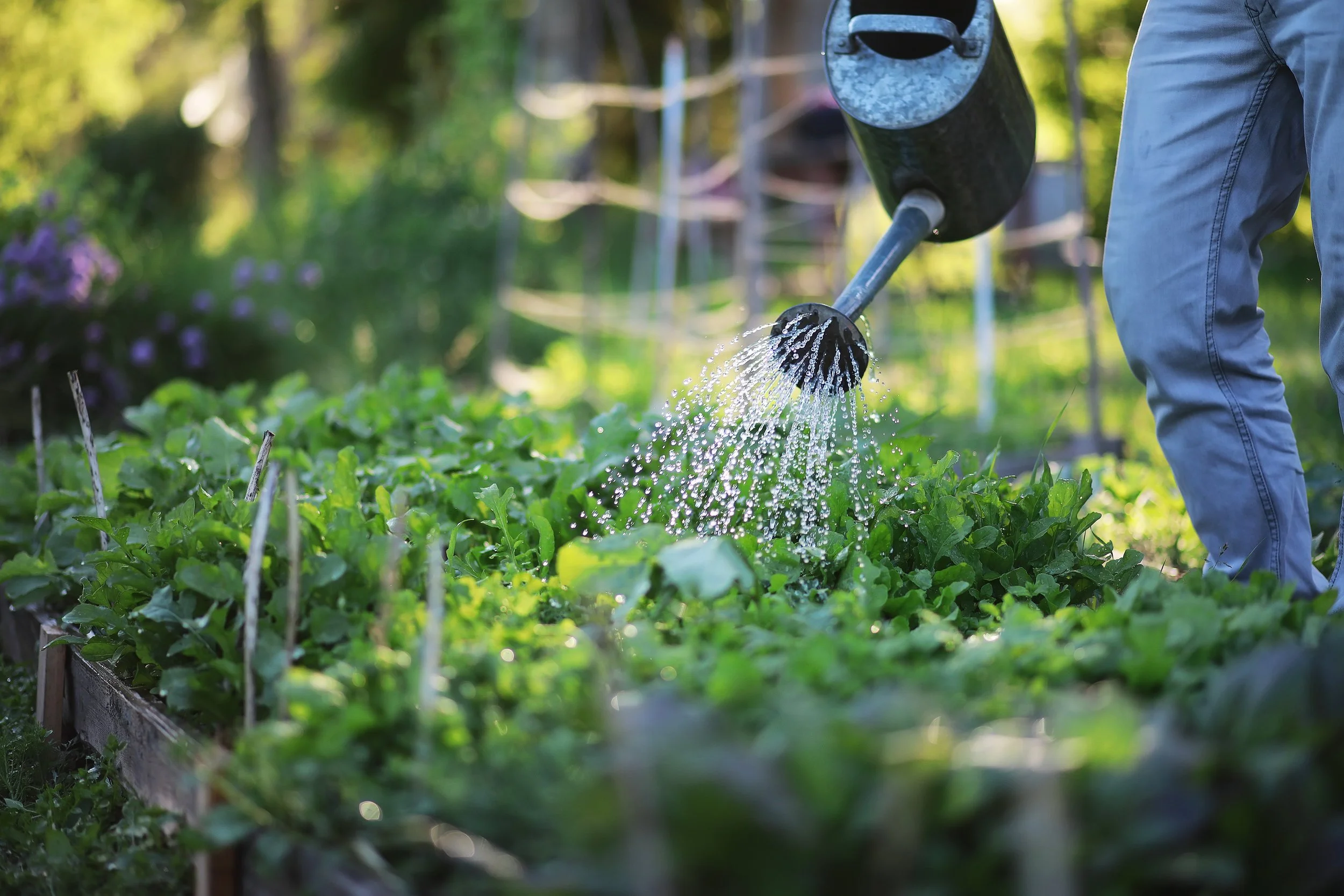
hand watering from hoses connected to well water or your city water supply
and flood irrigation
Other than hand-watering from a hose, we recommend all these methods be connected to remote controlled automatic valves so you don't have to remember to turn the water on and off. When everything that's established is on an automatic system, there's no need to worry if you remembered to water or if you go out of town which saves you time and money. But maybe you enjoy hand watering - do what’s good for you!
With drip irrigation you'll save time by only needing to hand water when starting seeds or immediately after transplanting. It has a very low evaporation rate which saves water by delivering it straight to the soil surface where the plants need it. It can be set to run for longer periods of time (up to an hour in amended moderately fertile, well-draining soil) without running all over the place like a sprinkler head might after about 30 minutes. Watering longer and less often encourages deep root growth in most plants which makes for stronger, healthier plants! Yay.
What you'll see us use:
1/2" above ground inline drip tubing, emitting 0.9 gallons per hour with 6-12" emitter spacing for vegetables and high water use plants, and 12-18” emitter spacing, emitting 0.9 to 2 gallons per hour for dense plantings of trees and shrubs. We recommend keeping the high water use plants on one zone and the lower water use plants on a separate zone when possible. For more spaced out plantings; above-ground 1/2" poly tubing with customized emitter placement called “Point-Source Emitters”.
If you can go the drip irrigation route, there's kits available through companies like DripWorks, Orbit, or you can ask a professional for help at a local irrigation supply store, which we prefer! RainBird and others have free online manuals for irrigation design and set up. It is possible to convert pop up sprinklers to drip if you'd prefer that over installing a new line, but because of differences in pressure and run times, we recommend having drip on a separate zone from over-head sprinklers.
Drip irrigation is compatible with well pumps, city water, canal water, and already installed over-head sprinkler systems just make sure you have a filter installed up stream and the correct pressure for your components! Your local irrigation supply store might have a list of irrigation contractors if needed.
Netafim are the products we use most for drip irrigation tubing and components and so far they've lasted many years in our landscapes. We are not sponsored or affiliated with any of the above companies. Here’s a video Gabrielle made to do your own drip conversion.
The less soil is exposed, the less water will evaporate. You can mulch with bark or chipped gravel applied over the tubing(aim for 4-6 inches), and plant in such a way that once mature, the spread of plants shade most of the ground.
The length of time to water with drip irrigation varies based on soil structure; the percentages of sand, silt, and clay that make up the bulk of the soil and the texture which is the combo of sand, silt, and clay paired with decomposing matter (like compost, leaves, dead plant roots etc), which creates the foundation of how the soil holds together, has drainage, nutrient holding capacity, and spaces for oxygen and water. We encourage you to do a little at-home soil texture test like this:
At https://hgic.clemson.edu/factsheet/soil-texture-analysis-the-jar-test/
Once you calculate your percentages of these materials, find your soil texture using a “Soil Texture Triangle”
Once you have an idea of your Soil Structure and Texture, this enables you to amend your soil accordingly. In Idaho's Treasure Valley, we have a generally Sandy Clay, or Clay soil. With the exception of xeric or native plant gardens, we spend a lot of time adding organic matter like composted manure, bark, leaf mold, or plant based compost to increase nutrients for more hungry plants.
Water this often for trees, shrubs, and perennials in amended soil that drains well: plants that have been in the grown for less than a year for about 40mins each time 4-5x per week in Spring, Summer, and Fall with supplemental hand watering when needed. Established plants that have been in the ground for over a year are watered 1 hour each time 1-2x per week in Spring and Fall and 45mins-1 hour each time 2-3x per week in Summer. Please adjust as necessary for your specific plants, sun exposure, wind, mulch and soil drainage. Check the soil moisture by digging past mulches and into the soil about 5-6 inches down and adjust water duration and frequency as needed.
Lawn and annuals need to be watered more often for shorter run times; 15-30mins each time several times per week depending on sun exposure, wind, and soil drainage.
The run times would need to decrease and frequency potentially increase with heavy clay soil or super well-draining sandy soil but this needs to be specifically set to your unique soil which may require some fiddling to get it right.
Cover your soil
Mulching over bare soil retains moisture and adds to your Soil Structure over each season as it incorporates or decomposes. Some common mulching materials are
Fine wood bark
Straw
Compost
Living Cover Crop when beds aren't planted
Over-head sprinklers for the vegetable garden: It's a perfectly reasonable way to water, just keep in mind
Consistent water on foliage does encourage powdery mildew to build up, but planting in full sun so the plants can dry out before nightfall, and ample spacing between plants so there's lots of air circulation, can help prevent it.
You may need to add additional length via risers to the spring loaded heads so when plants become taller, they still receive water and the heads don't get blocked. This is a method low maintenance flower beds and some large outdoor nurseries use to keep the pots watered on an automatic system.
You may need to water twice per day in the hottest and most active growing months because of the higher evaporation rate and the less direct water to soil contact.
Water in early morning. This preps the plants with the water they need before the temperatures rise and less water evaporates as it is sprayed from the nozzles.
Flood irrigation is commonly found in neighborhoods zoned for agricultural purposes, or older properties. This is not my area of expertise but is important to note. The water is fed from a shared canal that runs the length of the neighborhood's streets from a larger canal system. If you have this available to you, you should have someone in your neighborhood who's in charge of it. This method has been known to have a 50% evaporation rate. Not great for efficiency, but great for low budgets & high quantity! In the high desert, a vegetable garden needs to be watered several times per week to get established. Flood irrigation is available once per week in most cases, so additional water is needed. Flood irrigation can be used in combination with a pump and automatic system. These pumps need to be primed and winterized properly to keep them running year after year similar to the winterizing of a back flow prevention device and underground irrigation system.
Hand-watering is the most time consuming method. Depending on the scale of your garden, it can be a relaxing way to start your day - checking on the garden and watering plants. This method almost always has to be when you first direct sow seeds or transplant starts. Every plant has a very fragile root system when it’s just beginning so hand watering is essential to get it going. We try not to use this method solely for watering established plants. Depending on soil moisture holding capacity, you may need to water everyday with a well-drained soil that has lots of sand or every other day with a soil that's more clay or compost until things are established and in particularly hot months (temps above 85° F.).
Recap:
Always water in the morning if possible and potentially in the afternoon for 20 minutes to cool off the garden if needed.
If you haven't done a soil test yet (through a university extension or at home), stop and do that before you decide how to water. Your soil will drain or hold water depending on how it's composed. This will tell you how long and how often you need to water, how many gallons per hour you should apply, and how far apart to space watering emitters if you're choosing inline drip tubing.
Always hand-water your new plants every one to two days until they're established.
Have supplemental water available if your primary resource comes from flood irrigation or other seasonal canal.
If you travel or don't want to spend a lot of time watering, set up some form of automatic system
Ask lots of questions at your local irrigation supply store if you're uncertain.
Hiring a professional Irrigation Technician can be a huge time-saver